This article is based on real observations of early-stage TikTok seller accounts, common beginner posting behaviors, and repeated performance patterns seen across multiple product niches. The insights reflect practical experience analyzing how TikTok distributes content to new accounts and why most beginners fail to build a sustainable learning loop in their first month.
 +
+
Intro: Why the First 30 Days Feel So Chaotic for Beginners
For most beginners, TikTok feels exciting at the beginning—and confusing very quickly.
You post your first video and it gets a few hundred views.
The second one suddenly gets thousands.
Then the next three barely move at all.
At this point, many beginners start asking the wrong questions:
- “Is my account shadowbanned?”
- “Did TikTok change the algorithm?”
- “Does TikTok even work for my product?”
In reality, nothing is “wrong” with your account.
What’s missing is a clear learning structure.
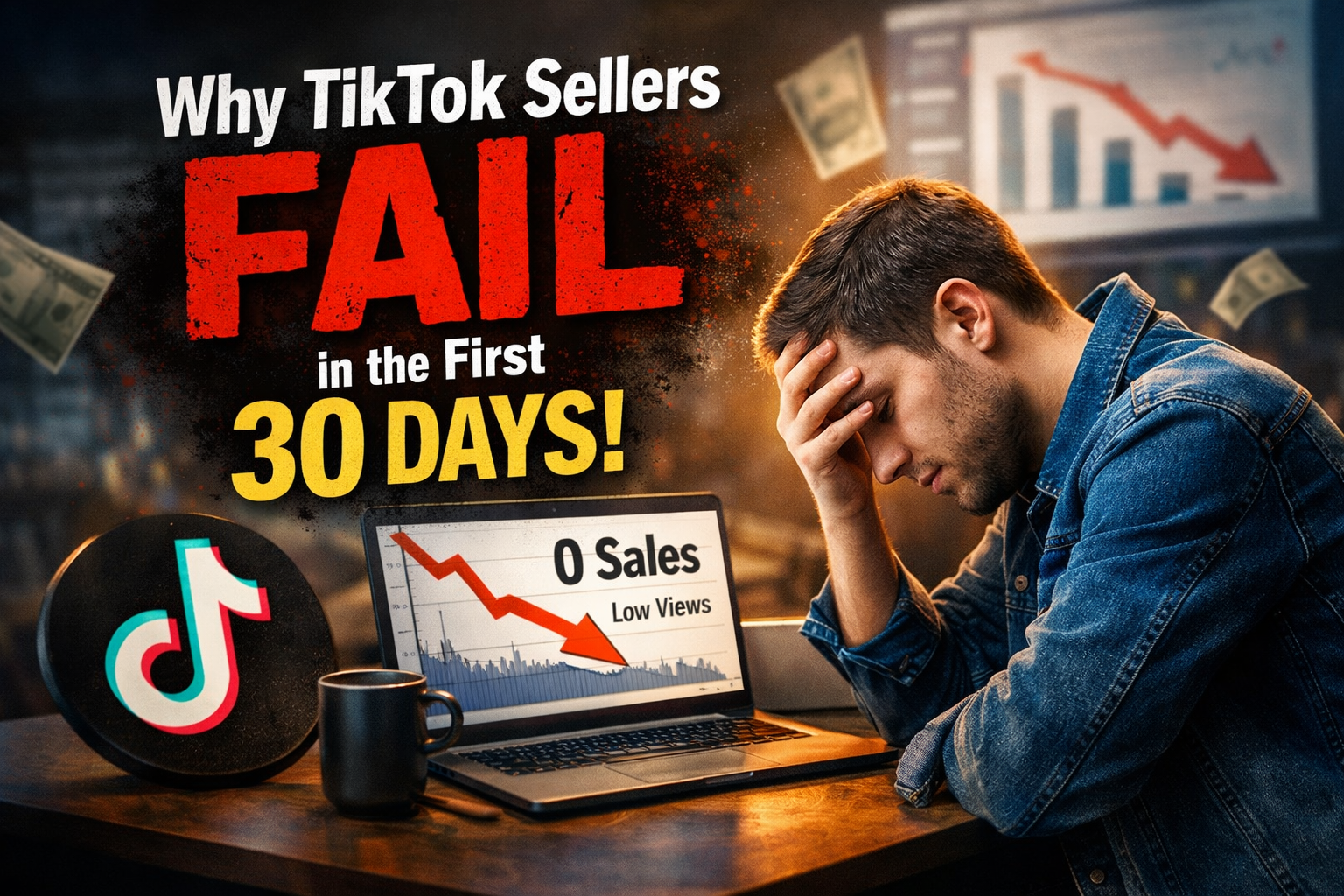
The first 30 days on TikTok are not designed to reward you with sales. They are designed to test whether you understand how the platform works. Most beginners don’t—and that’s why they quit early.
Section 1: The Real Reason Most TikTok Beginners Fail
The biggest reason beginners fail is simple: they post without a feedback loop.
Most new sellers focus almost entirely on:
These numbers feel good, but they don’t tell you what to improve next.
What beginners usually ignore are:
- Average watch time
- Where viewers drop off
- Saves
- Comments that ask questions
Without paying attention to these signals, every video becomes a guess. When guessing becomes the default, frustration builds fast.
Over time, this leads to burnout—not because TikTok is hard, but because progress feels random.
Section 2: How TikTok Actually Evaluates New Videos (Plain English)
TikTok does not punish beginners. It tests them.
Every video goes through a basic evaluation process:
- TikTok shows the video to a small test audience
- It measures how long people watch
- It checks whether viewers interact (save, comment, rewatch)
- Based on those signals, it decides whether to push the video further
If people leave early, the test stops.
If people stay and engage, TikTok expands reach.
This is why followers count barely matters in the beginning.
A small account with strong watch time will always beat a big account with weak engagement.
Understanding this alone already puts beginners ahead of 80% of new sellers.
Section 3: What Beginners Should Do Step by Step in the First Month
Instead of posting randomly, beginners should follow a simple, repeatable process.
Step 1: Post one video per day
Not three. Not five. One is enough if you actually review performance.
Step 2: Focus on one clear message per video
Don’t explain everything. One problem, one idea, one takeaway.
Step 3: Review performance after posting
Look at:
- Watch time
- Completion rate
- Comments
Ask yourself: Where did people lose interest?
Step 4: Improve only one thing in the next video
Maybe the hook. Maybe the pacing. Maybe clarity.
This creates a learning loop. Without this loop, posting more content only creates more confusion.
Section 4: Common Beginner Mistakes Observed in Real Accounts (EEAT)
Based on observing many early-stage TikTok sellers, the same mistakes appear again and again:
- Posting random ideas with no connection
- Changing niches every week
- Chasing trends without understanding why they work
- Ignoring comments that actually contain content ideas
These behaviors block learning. TikTok growth doesn’t come from creativity alone—it comes from pattern recognition.
Beginners who slow down and observe patterns consistently outperform those who post blindly at high volume.
Section 5: Guessing Content Ideas vs Using KOLSprite
When beginners rely on guessing:
- Every post feels risky
- Failure feels personal
- Progress feels slow
Using KOLSprite changes this dynamic completely.
Instead of guessing, beginners can:
- See which videos already perform well in their niche
- Identify repeatable formats across different creators
- Understand what TikTok consistently rewards
This doesn’t kill creativity—it removes unnecessary uncertainty.
Beginners using data-backed inspiration improve faster because they are learning from success, not experimenting in the dark.
Table: Beginner TikTok Strategy Comparison
 +
+
Actionable Takeaways for Beginners
- Focus on learning, not sales, in the first 30 days
- Track watch time and comments, not just views
- Improve one thing per video
- Use proven formats instead of guessing
- Treat TikTok as a system, not a lottery
CTA
Want to avoid wasting your first 30 days on TikTok? Download KOLSprite and see what works before you post.

 Refer & Earn